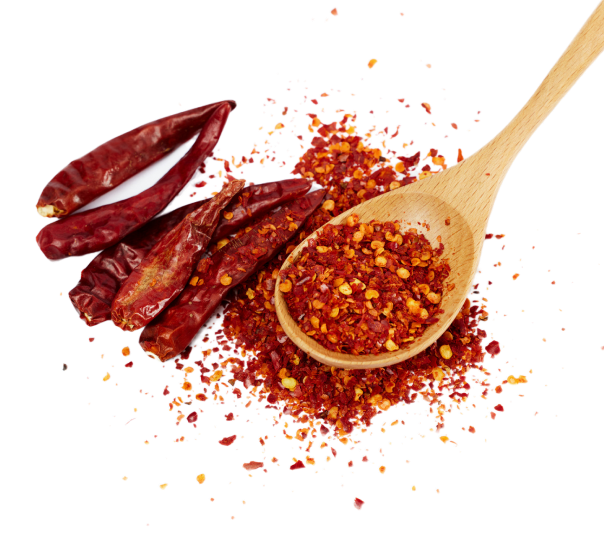




How We Control Foreign Matter in Chili Crushed and Paprika Crushed
When purchasing chili crushed and paprika crushed, product quality is about more than color, heat level, and flavor. Foreign matter control is equally important. At Tiancifeng Foods, we use X-ray inspection and AI color sorting technology as two important measures to help identify and remove unwanted materials during processing.
Why Foreign Matter Control Matters in Crushed Chili Products
For food manufacturers, spice processors, and ingredient distributors, the cleanliness of raw materials directly affects production efficiency, food safety management, and the quality of finished products.
This is particularly important for Chili Crushed Products and Paprika Crushed Products. Unlike whole dried chili peppers, crushed products consist of smaller particles, making it more difficult to identify and remove unwanted materials during processing.
Depending on the raw materials and processing environment, potential foreign materials may include:
Plastic fragments: Small pieces of plastic that may enter the product stream from packaging materials or other sources.
Metal fragments: Metallic particles that may enter during processing, including through equipment wear.
Hair and fibers: Unwanted materials that require careful control during handling and production.
Chili stems: Remaining stem pieces that may affect the appearance and specifications of crushed chili products.
Discolored particles: Abnormal product pieces that do not meet the required visual quality standards.
These materials have different physical characteristics. Some can be identified through visual inspection, while others require different detection technologies. This is why relying on only one inspection method may not be sufficient.
At Tiancifeng Foods, foreign matter control is an important part of our quality control process. We use different inspection methods to help maintain product consistency and reduce the risk of unwanted materials entering finished products.
1. X-ray Inspection: Helping Detect Foreign Materials Inside the Product
X-ray inspection is an important part of our foreign matter control process. The technology analyzes differences in X-ray absorption between food products and potential foreign materials.
Materials with different densities and physical properties may produce different signals in the X-ray image. Based on the equipment configuration and detection parameters, the system can help identify certain foreign objects that may be difficult to recognize through ordinary visual inspection.
For chili crushed and paprika crushed, X-ray inspection can help detect certain dense foreign materials, including some metal, glass, and stone particles. Actual detection performance depends on factors such as material composition, particle size, product thickness, and equipment settings.
Why Is X-ray Inspection Important for Chili Products?
Crushed chili products have irregular particle shapes and varying thicknesses. Some foreign materials may be difficult to distinguish from the product through visual checks alone. X-ray technology provides an additional inspection method based on physical properties rather than color.
This makes X-ray inspection a valuable part of a broader quality control system, especially when supplying food manufacturers that require consistent raw material standards.
2. AI Color Sorting: Identifying Unwanted Materials Through Visual Recognition
While X-ray inspection focuses on differences in X-ray absorption, AI color sorting works through optical recognition. The equipment uses cameras, image processing, and configured recognition models to analyze the appearance of individual particles as they pass through the sorting system.
Depending on the sorting configuration and product characteristics, the system can help distinguish unwanted particles based on differences in color, shape, and visual appearance.
What Can AI Color Sorting Help Identify?
Chili stems: Visible stem fragments that differ from the required product appearance.
Discolored particles: Unusual color variations and visibly abnormal product pieces.
Some plastic materials: Foreign materials with recognizable differences in color or appearance.
Other visible defects: Unwanted particles that can be distinguished according to the equipment's recognition settings.
When the system identifies a particle that meets its rejection criteria, the sorting mechanism can separate it from the accepted product stream.
For crushed chili and paprika crushed, this process helps improve visual consistency and reduce the presence of identifiable unwanted particles.

3. Why We Use Both X-ray Inspection and AI Color Sorting
X-ray inspection and AI color sorting serve different purposes. One technology analyzes physical density differences, while the other identifies visual differences. Neither method can reliably identify every type of foreign material under all conditions.
Using both technologies provides complementary inspection capabilities and helps us address different types of foreign matter risks during the processing of chili crushed and paprika crushed.
| Inspection Equipment | Detection Principle | Main Inspection Focus |
|---|---|---|
| X-ray Inspection Machine | Differences in X-ray absorption and density | Certain dense foreign materials, such as metal, glass, and stone |
| AI Color Sorting Machine | Optical imaging and visual recognition | Visible chili stems, discolored particles, and recognizable foreign materials |
For example, a small metallic fragment may not have an obvious color difference from the surrounding chili particles. An X-ray inspection system may provide an additional detection opportunity. On the other hand, a visible chili stem or discolored particle may be more suitable for optical sorting.
These inspection technologies are particularly important for crushed chili products, where irregular particle shapes and different physical characteristics can make foreign matter identification more challenging.
By combining these two technologies, we aim to reduce the possibility of unwanted materials remaining in the finished product and improve the consistency of our inspection process.
4. What Should Buyers Check When Choosing a Crushed Chili Supplier?
When evaluating a supplier of chili crushed or paprika crushed, buyers should look beyond product photographs and price quotations. A reliable supplier should be able to explain how foreign materials are controlled and how product specifications are maintained throughout processing.
Here are four practical questions worth asking before placing an order:
1. What Foreign Matter Detection Equipment Is Used?
Ask whether the factory uses X-ray inspection, optical sorting, metal detection, or other suitable inspection methods. More importantly, understand what each piece of equipment is designed to detect.
2. How Are Chili Stems and Discolored Particles Controlled?
For crushed chili products, the removal of unwanted stem pieces and abnormal particles is an important part of visual quality control. Ask how the supplier manages these materials and whether the sorting parameters match your product requirements.
3. Can the Supplier Provide Product Specifications and Test Reports?
Buyers should confirm the required specifications for particle size, moisture, color, heat level, and other relevant quality indicators. Where applicable, request a Certificate of Analysis (COA) and supporting test documentation.
4. Can the Supplier Meet Your Specific Application Requirements?
Different food applications require different raw material characteristics. A supplier should understand your target application, processing requirements, and packaging preferences before confirming the order.
5. Our Commitment to Cleaner and More Consistent Chili Products
At Tiancifeng Foods, we understand that our customers need more than a supplier who can deliver chili products. They need a manufacturing partner who takes product consistency and foreign matter control seriously.
Our X-ray inspection and AI color sorting equipment are two important parts of our approach to controlling unwanted materials in chili crushed and paprika crushed. Together, they provide complementary inspection capabilities and help us maintain our product quality requirements.
We also recognize that effective foreign matter control depends on more than equipment alone. Raw material management, hygienic handling, production procedures, equipment maintenance, and appropriate inspection settings all play important roles.
Our goal is to provide customers with chili products that meet their agreed specifications and support their downstream food manufacturing needs.
Looking for a Reliable Chili Crushed or Paprika Crushed Supplier?
Whether you are a food manufacturer, spice distributor, importer, or private-label brand, Tiancifeng Foods welcomes the opportunity to discuss your sourcing requirements.
If you are looking for a reliable paprika crushed supplier, our team welcomes the opportunity to discuss your product specifications, quality requirements, and sourcing needs.
Contact our team to learn more about our chili crushed and paprika crushed products, available specifications, and quality control procedures.
Visit Tiancifeng Foods to learn more about our company and products.
Looking for a dependable chili products supplier? Get in touch with Tiancifeng Foods to discuss your requirements.